
Co-designing an evaluation together: Shaping how we learn and measuring what really matters in Rural County Durham
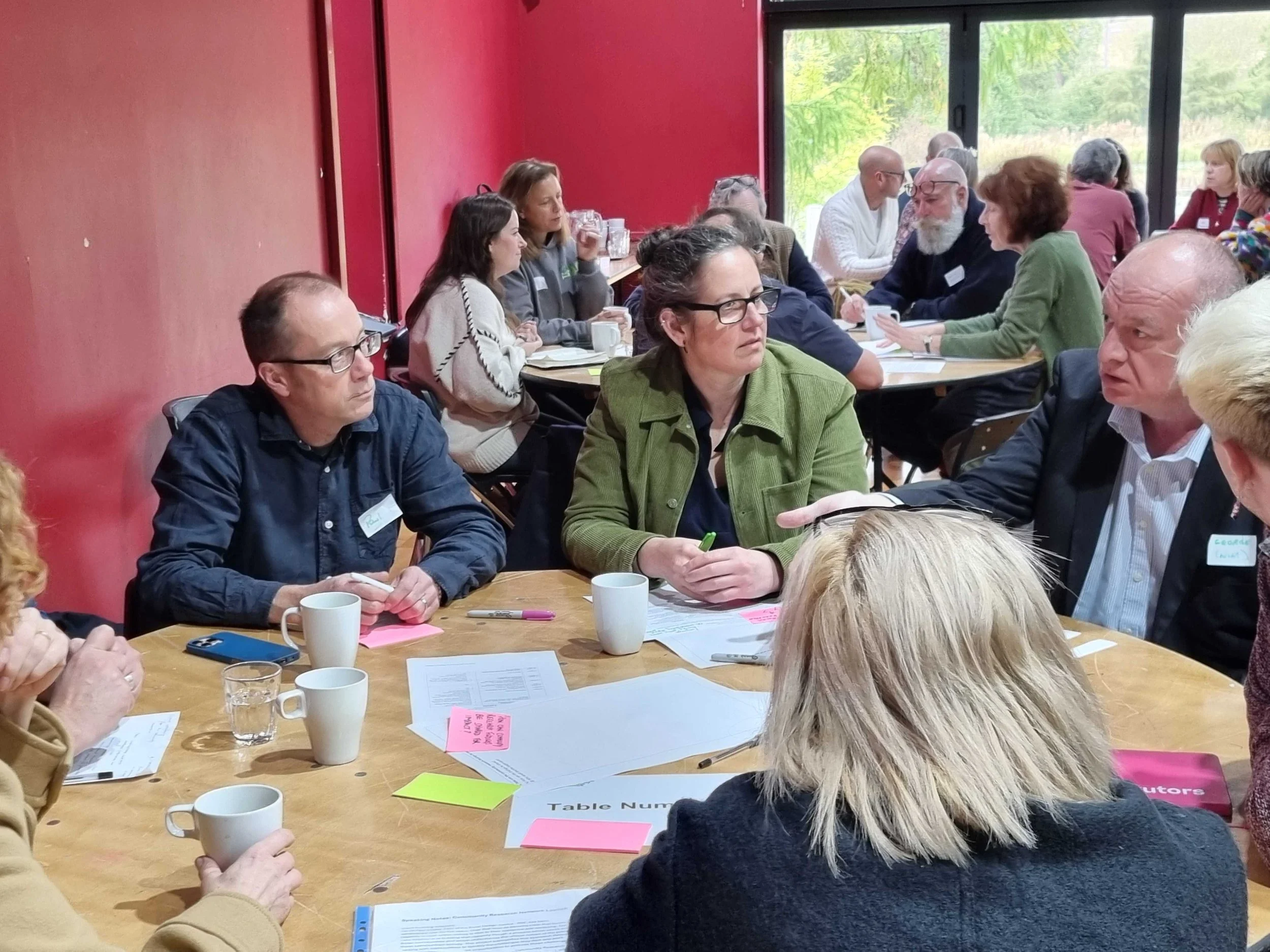
Launch event attendees in conversation.
Building a network informed by the communities it serves its crucial. Here Ben Fisher, Innovation Catalyst leading our evaluation and George Thirlaway a network member from Northumbria Industrial Mission talk about our approach to monitoring and evaluation.
Monitoring and evaluation (M&E) of projects, initiatives and organisations is often seen as a tick-box exercise or something done too stakeholders rather than with them. But when it’s co-designed with a mix of stakeholders in a participatory and inclusive way, M&E becomes an important tool for learning, responsibility and collective impact that really reflects and measures what’s important to those involved.
As part of the Rural Durham Community Research Network (CRN), Innovation Catalyst has been working on behalf of the core CRN partners: the Rural Design Centre, Durham Community Action and Durham University, to co-design the CRN’s M&E framework that is relevant, practical and useful to everyone. Instead of starting with a ready-made model, the network has built it together — through conversations, online workshops and shared reflections — making sure it captures what really matters to people living and working in Teasdale, Derwent Valley and Weardale.
For the purposes of this work, we define “rural” as areas characterised by low population density but with strong local connections, open spaces and natural environments often with limited access to services compared to urban areas. Rural communities face unique social, economic, and environmental challenges, and understanding this context is central to meaningful M&E.
At the heart of the process for developing the M&E has been the involvement of our community researchers, core delivery team and voluntary, community and social enterprises (VCSEs) that make up the CRN. Together, they brought local knowledge, experience and creativity into every stage. Their insights have helped shape a framework with a shared purpose, set of principles and values, key evaluation questions and an approach to research methods, collection, analysis and reporting which is practical, iterative and flexible.
By working in this participatory way, we’ve not just designed an M&E framework — we’re strengthening relationships, building shared understanding and ownership, and creating something that will continue to grow and capture the story of change within the network over time.
You can find out more about our approach to monitoring and evaluation here.